Where Zara fits
Zara is where a workflow starts, but it's one piece of a runtime built from three connected surfaces. Zara builds the team. Zen Studio is where engineering opens it up, sets exactly how far it's allowed to go, and chooses where it runs. Zen Pilot is where it actually runs, and where every decision gets explained in a sentence you can read. All three run the same governed cycle underneath.
You say what you need. She builds it in front of you.
No template library to search through. No empty grid waiting for you to know what an agent architecture is supposed to look like. You type the job, and Zara starts filling seats.
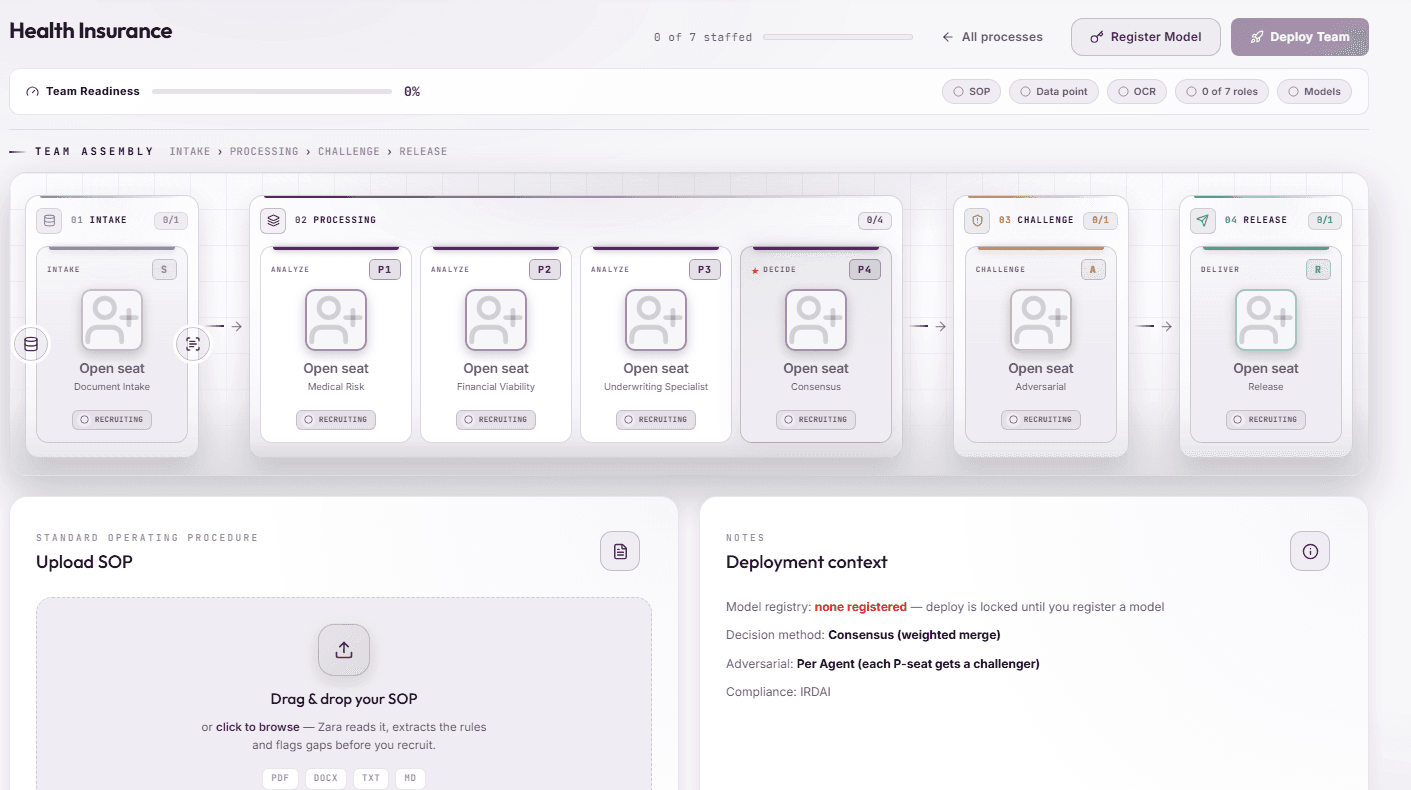
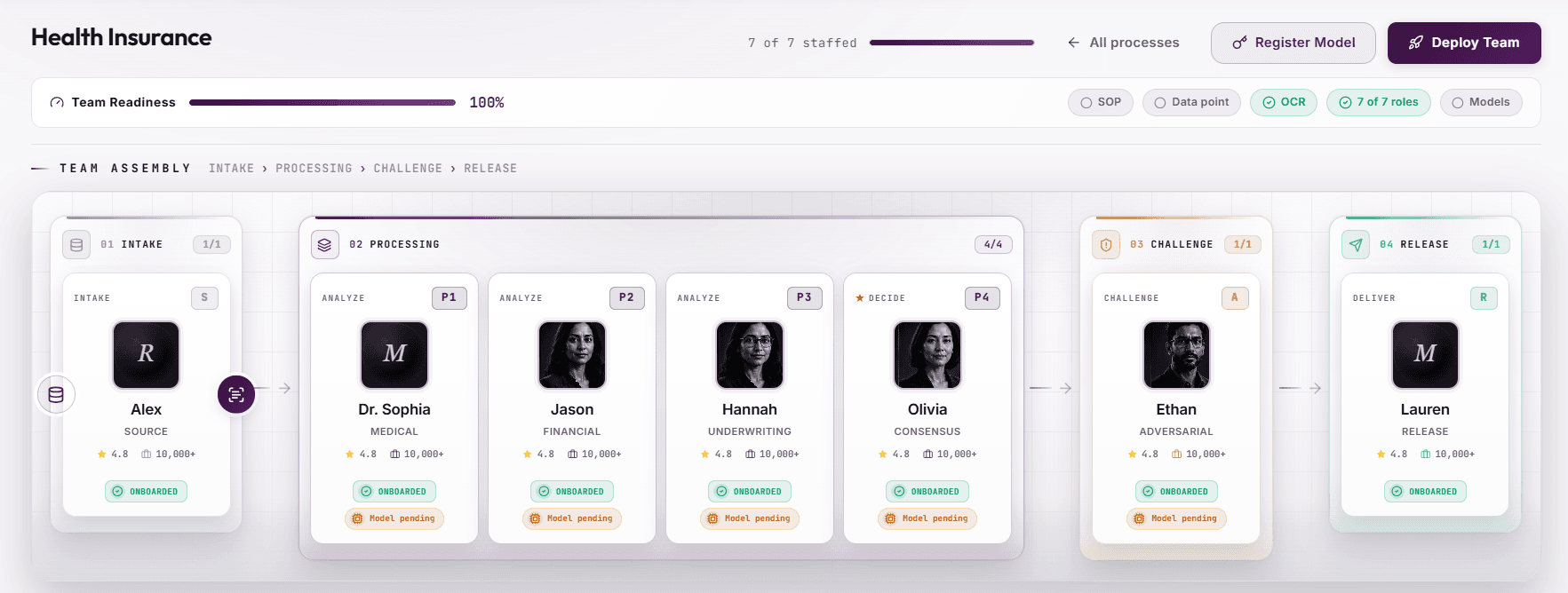
Type "health insurance underwriter" and within the same conversation, Zara has already picked a Source agent to ingest applications, four Process specialists split across medical, financial, and underwriting review, a Consensus layer to catch disagreement, an Adversarial agent, and a Release agent to hold the gate. You're not configuring a workflow. You're watching one get proposed, argued for, and slotted into place in real time.
She tells you why, not just what
Every pick comes with a reason, written out where you can see it, not buried in a changelog you'll never open.
Zara, panel architect
Dr. Neha is in. Solid choice, she assesses medical history, lab reports, and lifestyle factors.
Mira is in. Good pick for an alternate, multi-jurisdiction releases and reinsurance cessions.
Panel is complete. Make it operational when you're ready.
That's the difference between a system that assembles agents and one that argues for them. If Dr. Neha's rationale doesn't match the case in front of you, you push back before the panel deploys, not three weeks into production when something's already gone sideways.
No seat is a single point of failure
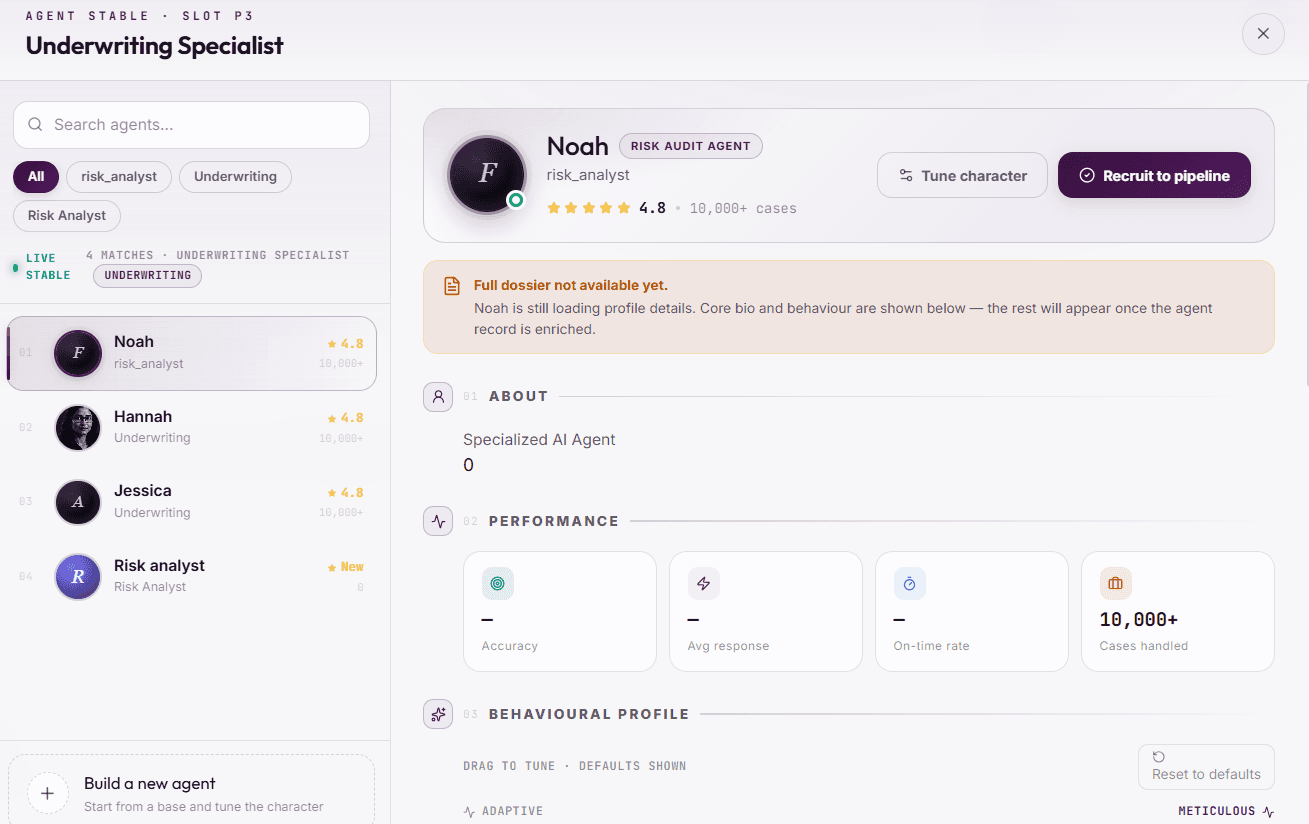
Every role on the panel comes with at least one alternate, already vetted, already labelled with what makes them different.
PrimaryDr. Neha
Assesses medical history, lab reports, and lifestyle factors for the standard case.
AlternateDr. Mei
Specialist in metabolic and cross-condition cases, the ones the standard reviewer would flag and pass along.
Swap the seat, not the workflow. A source agent built for high volume document intake sits behind Sia by default, with Ren, tuned for exactly that kind of throughput, ready to take over the moment volume spikes past what a single agent should carry alone.
Open any seat, and the configuration is real
Not a black box with a name attached. An Operating Brief in plain text, an engine choice with the dials exposed, and the domain parameters that make the difference between a generic underwriter and one that actually knows UAE rules from Saudi ones.
0.2temperature, set per agent, not platform wide
UAEa jurisdiction parameter, not a hardcoded assumption
1024token budget, visible and adjustable
The shape of the team, before you commit to it
A dependency graph most platforms only show you after something's broken. Zara shows it to you before you press deploy.
You can trace exactly what happens between the application landing and the decision leaving. Not because someone documented it after the fact, but because that's what the map already shows, before a single case has run through it.
The conversation is with the process owner, not the developer
Not engineeringTalks to whoever runs the process
The underwriter, the claims lead, the compliance officer. Not a developer translating their requirements secondhand.
Before buildCatches the SOP arguing with itself
Reads the document you hand over and flags where two sections quietly contradict each other, before either becomes an agent's instructions.
LiveCost and time, before you commit
An estimate while you're still deciding, not an invoice after the fact.
Common questions about Zara
Do I need to know how to write prompts?
No. Zara asks the questions a consultant would ask, in plain language. You answer, she drafts.
What if I don't have a written SOP?
Zara can start from a description of the process. A written SOP just gives her more to check for contradictions before anything gets built.
Can I change the team after Zara builds it?
Yes. That's exactly what Zen Studio is for, opening the draft, adjusting the guardrails, and versioning it before it goes live.