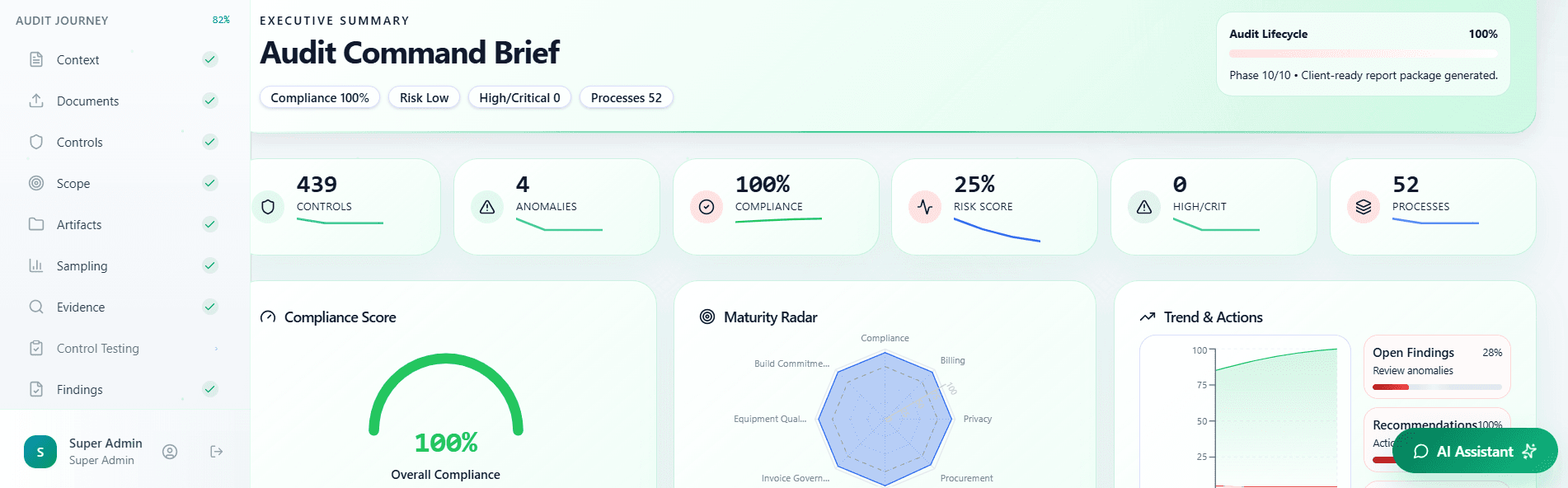
AuditOS moves internal audit from sample-based testing to full population review, without adding headcount, and without losing the auditor's sign-off on a single finding.
A governed audit and compliance module built on the same runtime as the rest of Zentis: every transaction tested, every finding gathered with its evidence attached, and every sign-off still resting with a named auditor.
AuditOS runs as a VPC-native deployment or fully on-premise, with regulatory grounding built for markets like India, where RBI Master Directions and IFRS requirements shape what a defensible audit actually has to show. It's not a dashboard bolted onto your existing audit management system. It's the testing and evidence layer underneath one.

From audit functions of every size, in every market we've worked in.
Sample-based testing at 10% coverage means ninety percent of transactions never get a second look, and nobody chose that on purpose, it's just what the cycle allowed for.
Auditors spend most of a six week cycle assembling documentation, not deciding what it means.
By the time a finding reaches a senior auditor, most of the work was data entry, not analysis.
Logs get reconstructed into a narrative once a regulator requests it, instead of existing as the work happened.
Not a feature list. The actual sequence, from the moment an engagement opens to the moment a finding is signed.
An auditor sets the engagement scope and the control universe. This isn't guessed at or auto-assigned, it starts with a human decision.
APIs connect directly to your systems of record, so transactions arrive without a manual export or upload.
Full population review runs against the control set as data arrives.
Documentation assembles live, so the evidence exists before anyone has to go looking for it.
Two separate checks: is the control designed correctly, and is it actually operating the way it's supposed to.
Results are compared to your existing procedures and to whichever regulatory pack applies, RBI Master Directions, IFRS, or another geography's requirements.
The record exists because it was built while testing happened, not reconstructed afterward.
The finding arrives drafted, with evidence attached. Nothing closes without a named person reviewing it first.
Different roles, different stakes, all covered by the same testing layer underneath.
Full population testing means the answer to "did we look at everything" is finally yes, not a defensible-sounding percentage.
A six week cycle spent gathering evidence becomes a cycle spent reviewing findings that already have theirs attached.
The record a regulator wants already exists, because it was built while testing happened, not reconstructed after they asked.
Eight core capabilities that turn periodic sampling into continuous, defensible assurance.
Full population review replaces sampling, across every business unit in scope.
APIs connect to your systems of record, no manual export required.
Checks whether a control is built correctly, and whether it's actually working.
Anything below the confidence threshold routes to a senior auditor automatically.
Deployed inside your own perimeter, including the models, where that's required.
Built with RBI Master Directions and IFRS requirements as first-class considerations, not an afterthought.
The audit trail exists from the moment testing starts, not reconstructed afterward.
No finding is final until an auditor has reviewed and signed it.
A direct comparison of operational mechanics and regulatory defensibility.
| Dimension | Sample-based audit | AuditOS |
|---|---|---|
| Coverage | A sample, typically 10 to 30 percent | 100 percent of transactions in scope |
| Evidence | Gathered manually, mostly by hand | Assembled automatically as testing runs |
| Audit trail | Reconstructed from logs after the fact | Built live, while the work is happening |
| Findings | Compiled by auditors before review | Drafted with evidence attached, reviewed and signed |
| Cycle time | Weeks, dominated by evidence gathering | Days, dominated by judgment |
Documents are hashed at ingest, so provenance is attached to every extracted field before an agent ever reasons over it. Deployment runs VPC-native by default, or fully on-premise, including the models, when that's required. Nothing leaves your perimeter unless explicitly configured to.
A six-week quarterly review cycle across the full transaction register was compressed into days, with every exception flagged and evidence attached.
Illustrative, based on the shape of audit workflows we've modelled. The real number depends on your control universe and business unit scope.
AuditOS deploys as a VPC-native environment or fully on-premise. GDPR compliant, SOC 2 and ISO 42001 certified, regardless of which option you choose. RBI Master Directions and IFRS are built in today, with additional regulatory packs added per geography as needed.
Bring one business unit and a quarter of transactions. Run full population testing against it and see what surfaces that the old sample would have missed, before deciding how far to expand it.