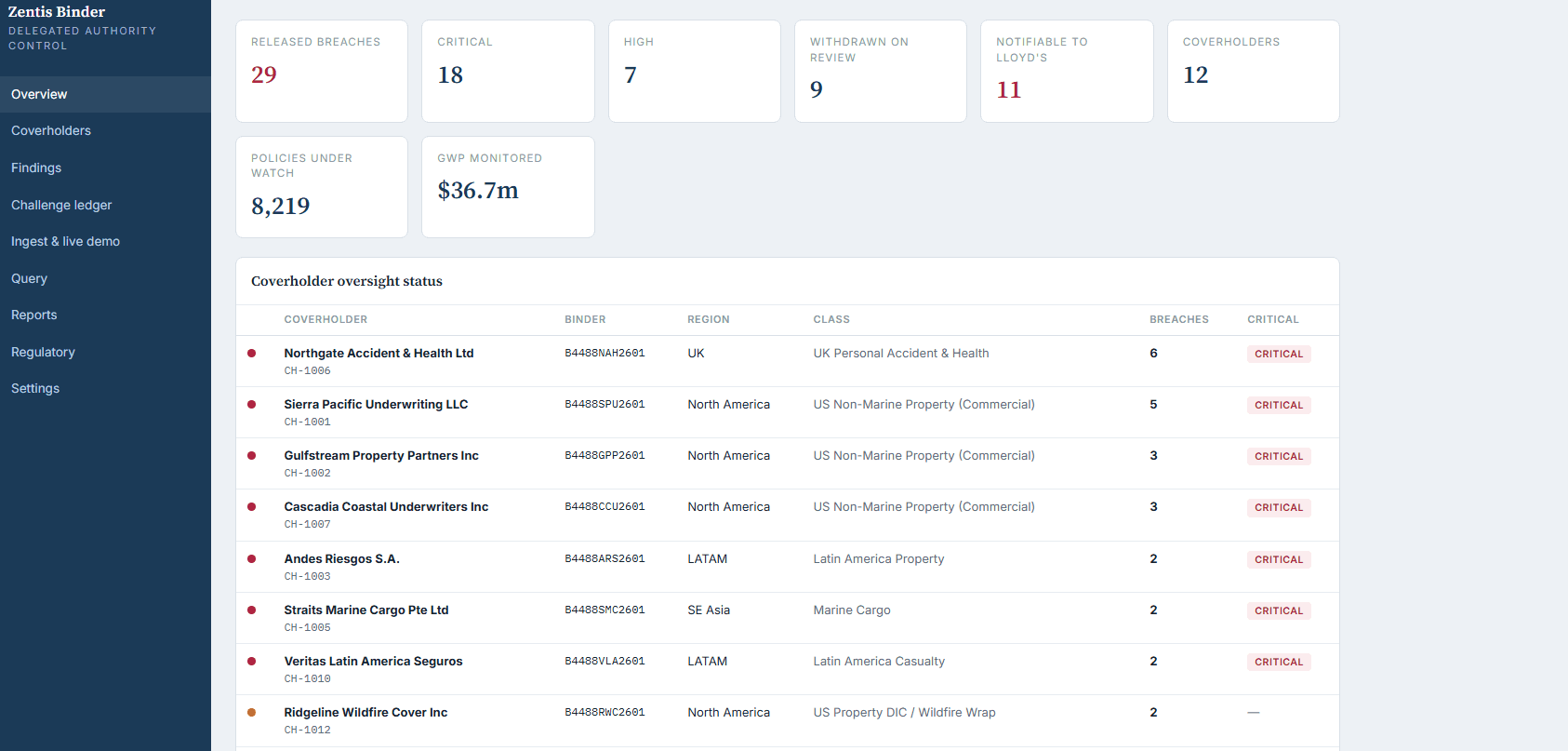
Every bordereau row, tested against the binder the moment it lands.
Zentis Binder replaces periodic, manual delegated authority oversight with continuous testing, deterministic and defensible, so a breach doesn't wait for a quarterly check to be found.
A real-time delegated authority oversight platform for the Lloyd's market. Every coverholder bordereau is tested against its binding-authority schedules on ingestion, with a clear audit trail from the source row back to the specific clause it breached.
Zentis Binder runs the same four-stage discipline as the rest of the platform, Source, Process, Adversarial, Release, but here detection is deterministic code, not a model's judgment. That's a deliberate choice: a breach finding has to be reproducible in front of Lloyd's and your compliance function, not just explainable. A connected model, when you choose to add one, only assists with schema mapping, writing the review narrative, and answering plain-language questions. It never decides whether a breach exists.
A breach, caught the moment it lands
A coverholder writes a risk. The insured's name is an exact match against a sanctions list entry. On a quarterly manual check, that sits unnoticed for weeks. Here, it's caught the moment the bordereau is ingested, and surfaces as a critical, notifiable finding in the same session it arrived.
The pain points we consistently hear
From managing agents and DA oversight teams working across a delegated book.
01
Oversight happens after the fact
A delegated book gets checked periodically, quarterly in most cases, against bordereaux that arrived weeks or months earlier. Whatever's wrong has already been wrong for a while by the time anyone looks.
02
Genuine breaches get lost, or coverholders get accused in error
Without a way to test for permitting endorsements or carve-outs automatically, oversight teams either miss the exceptions that would have excluded a finding, or spend hours manually clearing false positives.
03
Every coverholder sends bordereaux differently
Clean CSV, semicolon-delimited exports, Excel with header blocks, fixed-width scanned files, files with no currency column. Reconciling formats by hand eats the time meant for oversight itself.
04
The board pack gets assembled from a stale snapshot
By the time someone compiles the DA oversight committee pack by hand, the figures in it are already a week or two out of date.
Execution Discipline
How it actually runs
One continuous pipeline, from the moment a bordereau lands to the moment a breach is either confirmed or cleared.
01
Every format, one canonical shape
Bordereaux arrive in whatever native format a coverholder actually uses, and get parsed and normalised into one schema. Anything ambiguous gets logged as a data-quality exception, not silently guessed at.
02
Deterministic rules, not a model's opinion
Every row is tested against the binder's own schedules, limits, territories, excluded occupancies, sanctions, claims authority, by ordinary code. Each finding carries the source file, the row, and the exact clause it breached.
03
The control tests itself
Every finding is independently challenged. Where a permitting endorsement or contractual carve-out applies, the finding is withdrawn, and the argument that removed it is kept on record in a challenge ledger.
04
Notifiable, surfaced automatically
Surviving breaches enter the breach register. Sanctions, licensing, limit, and catastrophe breaches get flagged as Lloyd's notifications the moment they release, not the next time someone remembers to check.
Organisational Impact
Built for the person who has to answer for the book
Different roles, different stakes, all covered by the same testing layer underneath.
Head of DA Oversight
The coverage question
Every row of every bordereau tested on arrival, not a sample checked once a quarter.
Compliance & Lloyd's Oversight
The defensibility question
A finding traces to a specific clause in code, not a model's guess, so it holds up under scrutiny.
Managing Agent Leadership
The board question
The oversight committee pack is ready live, from the current book, not assembled by hand the week before.
What doesn't change
It produces the delegated authority oversight evidence and management information that underpins a managing agent's obligations to Lloyd's and the FCA. It does not produce statutory capital or solvency returns, QMA/QMB, the Lloyd's Capital Return, or Solvency II QRTs. Those stay with finance and actuarial, where they belong.
System Capabilities
Features
Deterministic accuracy, complete audit defense, and seamless integration for modern delegated underwriting.
Continuous, row-level testing
Every row of every bordereau, tested on ingestion, not sampled periodically.
Deterministic, defensible detection
Breach findings are code tied to a binder clause, reproducible under scrutiny.
Coverholder scorecards
Ranked by breach exposure, so attention goes where the book actually needs it.
Sanctions screening on ingestion
An exact or close match surfaces the moment a bordereau lands, not weeks later.
A challenge ledger that keeps its reasoning
Every withdrawn finding keeps the argument that removed it, on the record.
Natural-language query
Ask the oversight data a question directly, with an honest answer when it can't be mapped, not a fabricated one.
Live regulatory MI
Figures held against the Lloyd's and FCA reporting calendar, current at any moment.
Committee-ready board pack
Generated live, in one action, from the current state of the book.
Benchmark Comparison
Zentis Binder against periodic manual oversight
Dimension
Periodic manual oversight
With Zentis Binder
Review frequency
A quarterly review of bordereaux already weeks old
Duplicates caught row by row, never double-counted
Board pack
Board pack assembled by hand, already stale
Board pack generated live, in one action
Infrastructure
Architecture and security
A self-contained deployment inside your own environment. A model provider is entirely optional, and only ever touches the assistive functions described above, schema mapping, narrative writing, and query. Enterprise deployments integrate with your existing single sign-on and role-based access.
DELEGATED AUTHORITY OVERSIGHT
Bring one delegated authority book. See what continuous testing finds that the quarterly check would have missed.