If a team hasn't been drafted yet, that starts with
Zara. Once it's here, this is where engineering opens it up. Once it's configured, it runs in
Zen Pilot.
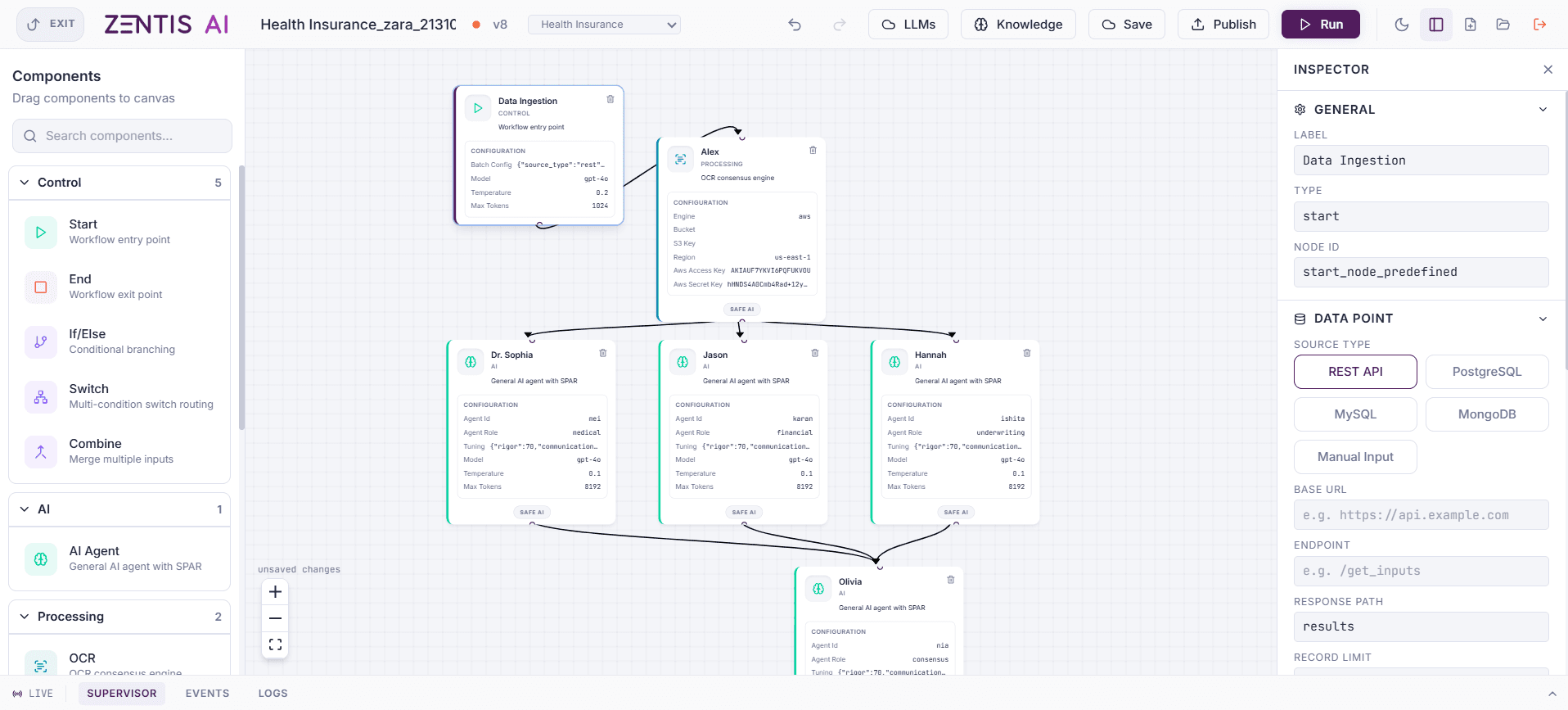
SPAR isn't a slide. It's the canvas itself
Every workflow you build runs the same four stages, enforced by the runtime, not a policy someone can quietly skip under deadline pressure.
SSource: deterministic intake, hashed at ingest
PProcess: specialists reason in parallel
AAdversarial: a different model tries to break it
RRelease: a named human signs off
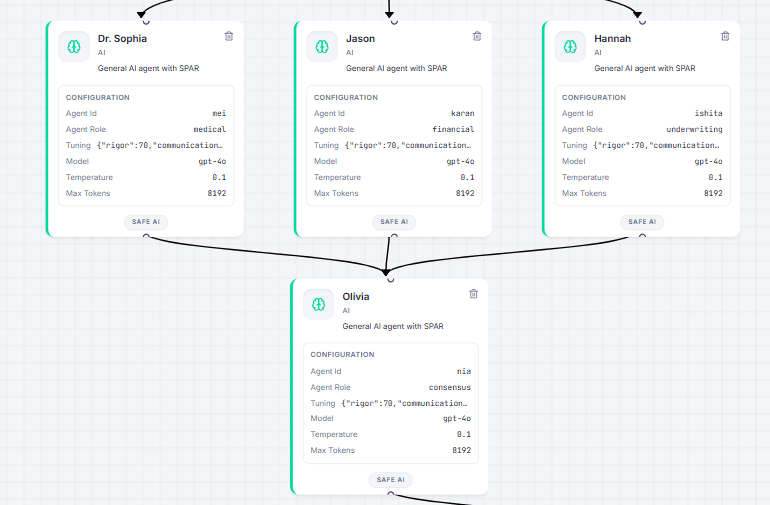
The canvas above runs Consolidation mode: three specialists work different parts of the same marine claim, merge into one record at the Chief Claims Officer node, and only then face the Adversarial Agent. Fastest path, lowest token cost, right for the volume of claims that don't need three independent opinions.
For the calls that do need three opinions
Consensus mode runs the same canvas differently: specialists answer independently, and where they land, together or apart, is itself the signal worth reading.
Consolidation and Consensus aren't two products. They're the same runtime, the same guardrails, the same Adversarial stage, applied at different intensities depending on what the case in front of you is actually worth getting wrong.
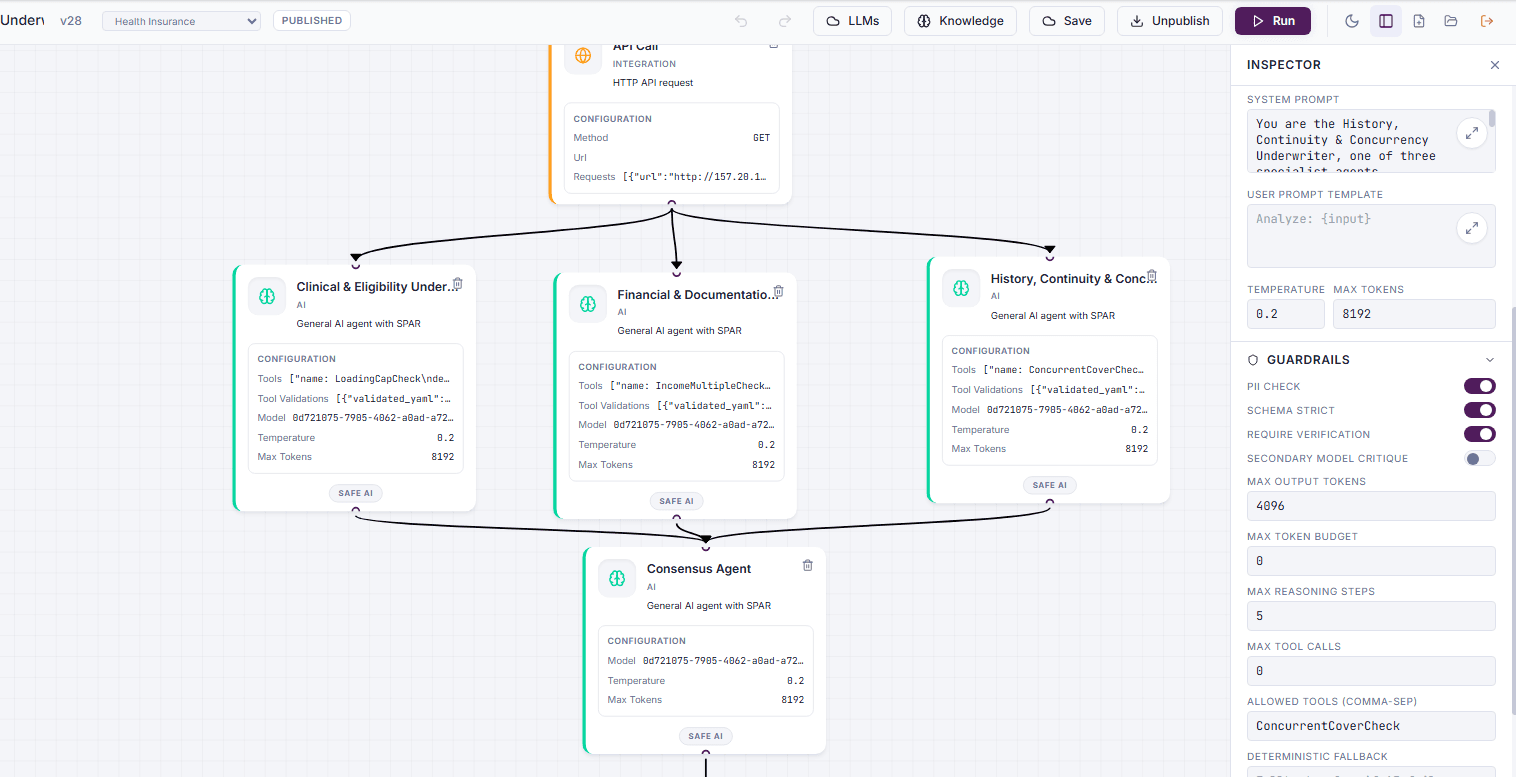
Every node opens to real configuration
Not a prompt box with a friendly name. A full inspector: system prompt, temperature, token limits, and the guardrails that apply before anything downstream ever sees the output.
On by defaultPII check, schema strict, require verification
Guardrails a node ships with, visible and toggleable per agent, not hidden three settings menus deep.
Named limits, not hopesReasoning steps, tool calls, allowed tools
An agent's ceiling is a number someone chose on purpose. A deterministic fallback covers what happens if it's ever reached.
The Stable: every agent this team can draw from
When Zara says "Dr. Neha is in," this is where Dr. Neha actually lives. 168 named agents, all mapping to six universal archetypes. Only the domain knowledge inside changes, which is why a new solution takes weeks, not months.
01Intake
Opens the case, classifies what it's looking at, routes it to the right specialists. Claims Handler, Lead Auditor.
02Domain Validator
Tests what's been found against the rules that actually apply. Policy Validator, Compliance Expert.
03Evidence Intelligence
Pulls, hashes, and cross-references the documents everything else depends on. Evidence Collector, Doc Intelligence.
04Adversarial
Tries to break the conclusion on purpose, from a different model than the one that reached it. The Skeptic, Fraud Investigator.
05Synthesis
Turns everything upstream into the artefact a human actually files. Report Writer, Board Pack Generator.
06HITL Gateway
Holds the gate. Nothing releases without a named human on record. Decision Officer, Approving Authority.
Deployment: where this actually runs
Same harness, wherever the data has to stay. Model choice is configuration, per agent, at runtime, not a decision you make once and live with.
Agent equals model plus harness. Only one half is yours.
Private cloudYour cloud, your subscription
Runs in your AWS, Azure, or GCP tenancy. Data never leaves your boundary, KMS keys stay yours.
SaaSManaged by Zentis
Multi-tenant or dedicated single-tenant. Instant start, zero infrastructure overhead for your operations team.
On-premise / air-gappedYour data centre, offline models
Bare metal or OpenShift in your data centre, using self-hosted open-weights models. Zero external egress.
ArabicEnglishHindiMalayalamBahasa
RBIIRDAICBUAEFCA & Lloyd'sOJK
Versioned, published, and still yours to reproduce
v41this workflow's current published version
PUBLISHEDstatus, visible at a glance, not buried in a settings tab
Pinnedprompts and rule packs locked to the version that shipped
A run from March and a run from September should agree with each other if nothing about the case actually changed. That's not a promise you take on faith, it's what pinning the version, the prompts, and the rule pack together is built to guarantee.
Common questions about Zen Studio
Can non-engineers build workflows in Studio?
Yes. The canvas is visual and drag-and-drop. Process owners routinely adjust thresholds and persona sliders without writing code.
How do you prevent a rogue agent from looping forever?
Every node has explicit step and token caps. If reached, the runtime invokes the deterministic fallback and notifies the supervisor.
Can we bring our own fine-tuned models?
Yes. Model endpoints are configured per node. You can mix OpenAI, Anthropic, open-weights (Llama, Mistral), or custom internal endpoints in the same workflow.
The build starts before this, and runs after it.